- REVIEWING ADVENTURES
- THE QUALITY OF THE EXPERIENCE
(implications for reviewing)
Reviewing vs. evaluation
Surviving without reviewing?
Combining action and reflection
Summary
- THE PURPOSE AND SCOPE OF REVIEWING
Five purposes of reviewing
The scope of reviewing
Summary
- MODELS OF REVIEWING
Integrated vs. segregated learning
Meeting personal and social needs
Matching review methods to developmental needs
Accentuate the positive or eliminate the negative?
Two families of learning models for reviewing
Family one: alternative models
Summary
- A SEQUENCE FOR REVIEWING
A four stage reviewing sequence
- TECHNIQUES FOR REVIEWING
(linked to the four stage reviewing sequence)
Summary
Reviewing and the transfer of learning and development
- REFERENCES
- RESOURCES FOR REVIEWING ADVENTURES
Preface to 'Reviewing Adventures'
Why should I feel the need to reassure other
adventurers that I am a friendly being who believes both in
the value
of adventure and in the value of reviewing?
In my own experience combining reviewing and
adventure is "win-win" - each enhances the other.
But some approaches to reviewing can kill
all
sense of adventure and can instantly reduce young people's
interest and
involvement to zero, or worse.
Reviewing can of course be boring or
irrelevant
if reviewers feel out of their depth or don't really believe
in what
they are doing. But I believe that there are much deeper
reasons why
reviewing does not always live up to its promise, and does not
always
'hit the mark'.
Most writers on reviewing (myself amongst
them)
emphasise the importance of following a particular sequence in
reviewing. After following the sequence, out comes the
'transferable
learning' from the adventure!
But what about the value of unreviewed
adventures - which every adventure educator knows about?
Is there not a direct conflict between those
who believe in the value of 'pure adventure' and those who
believe in
the value of 'processed adventure' (i.e. adventure that has
been
processed through reviewing)? And where there is such a
conflict, what
scope is there for compromise?
In this book, I have explored these issues,
and
I have proposed some solutions - both practical and
theoretical.
The book starts with some challenging
questions, then explores some models of learning and
development,
ending with descriptions of a number of active and creative
reviewing
methods.
INTRODUCTION TO
'REVIEWING ADVENTURES'
"Experience in itself is
neither productive nor unproductive, it is how you reflect on
it that
makes it significant or not significant for good or ill ..."
(Bolton, 1979)
Adventure education is a powerful medium in
which
to work. With power comes responsibility. It is precisely
because the
medium of adventure can be so powerful that adventure
educators have a
responsibility to find out what kind of impact adventurous
experiences
are having. And as educators, it makes sense to assist and
assess the
learning experiences which are aroused by adventure. Through
reviewing,
facilitators demonstrate that they care about what
participants
experience, value what participants have to say, and are
interested in
the progress of each individual's learning and development
(Greenaway,
1992).
Reviewing energises the process of learning
from experience. Some of the reviewing methods that are
possible after
an adventure fit the dictionary definition of 'review': "to
see, view
or examine again: to look back on or over: to survey: to
examine
critically: to revise..." (Chambers's Dictionary). But this
definition
does not convey the full range of methods that can be used to
enhance
learning and development after an adventure. 'Review' is a
word that
can sound cold, clinical and critical, as if it will produce a
sudden
(and solemn) change of climate following an intense or lively
experience. But the alternative terms for reviewing
('debriefing',
'processing' and 'reflection') are really no better at
suggesting that
a review can be as lively and involving as the adventure that
precedes
it.
Reviewing may be justifiable as being a
rewarding experience in itself. But how essential is it to the
process
of learning from experience? Is it always necessary to review
an
experience to learn from it?
- Are there not plenty of adventurous
experiences which are rewarding in themselves, and in which
the
learning is self-evident?
- Is not the outdoor environment valued
because it allows people to learn directly from the
consequences of
their actions?
- Surely adventures can be meaningful enough
without needing to make sense of them through reviews?
- When learning has already been an integral
part of the experience, should reviewing not be seen as an
optional
feature?
These are important questions to ask,
because the
experiences at the heart of adventure-based learning can be
substantially different in character to the kinds of
experiences which
feed other forms of experiential learning. The importance of
reviewing
does seem to depend on the nature of the experience, but to
conclude
that 'big' experiences need less reviewing, seems insensitive
and
irresponsible.
- How then, should the nature of the
experience affect the nature of reviewing?
- Is experiential learning theory (such as
that of Kolb, 1984) really so versatile that it can be
usefully applied
to any experience - from boiling an egg to climbing a
mountain?
According to the authors of "The Annual
Handbook
for Group Facilitators" (Pfeiffer and Jones, 1983) it is
"axiomatic"
that the processing stages of the experiential learning cycle
"are even
more important than the experiencing phase". They even urge
facilitators to be careful that the activity "does not
generate excess
data". Climbing a mountain or descending whitewater would
surely be
just the kind of experiences which would "generate excess
data"!
There
is clearly an enormous difference
between a way of working which advocates keeping experiences
down to a
reviewable size, and a way of working which is founded upon
a
philosophy of adventure.
The style of this book is a questioning one.
It
challenges readers to test out, or work out, their own
philosophy and
practice for reviewing in adventure-based learning. This
approach has
been adopted because it is a field in which there is such a
wide
variety of settings and purposes. There are also many
different sources
of practice from which a facilitator can draw inspiration for
reviewing. These might include, for example: action learning,
art
therapy, behaviour modification, counselling, developmental
groupwork,
educational drama, experiential learning theory, gestalt
psychology,
meditation, nature awareness, sensitivity training, values
clarification, visualisation, etc. Wherever the ideas come
from it is
important that there is a 'good fit' between the style of
reviewing and
the experiences generated by the adventure. This will help to
ensure
that what is gained through adventure is not lost through
review.
When the reviewing style 'fits', learners
sense its value, and it is then the whole process - of
activity and
review - that becomes the adventure.
It is when activity and review are working
well
together that the real adventure takes off - the adventure of
personal
and social development. It is an adventure which includes
three
interdependent elements:
- new and challenging activities
- new group experiences and
- new ways of learning
The challenge is to discover ways of merging
these three elements rather than attempting to depend on any
one model
or sequence as a guide for practice.
In the short term, a single element may
dominate the experience, but ultimately this dynamic form of
education
depends on the harnessing and intermixing of these three
sources of
adventure: the activity adventure, the group adventure and
the learning
adventure.
Some
of the ways in which these three elements
can be combined are explored on the following pages - with a
special
emphasis on reviewing.
Sorry - 'Reviewing Adventures' is now out of
print
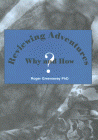
Reviewing Adventures: Why and How?
Author: Roger Greenaway
Publisher: National Association for Outdoor Education (1996)
ISBN: 1 898555 01 X
Please
use the articles
index to find old and new
writing on related themes.
|
![[INDEX]](images/suncloud.gif)